



Today's Mishnah Yomi
Kilayim 2:11 - 3:1
The Mishnah Yomi for Wednesday, December 29, 2027 is Kilayim 2:11 - 3:1
Mishnah 1
Mishnayos Kilayim Perek 2 Mishnah 11
כלאים פרק ב׳ משנה י"א
Mishnah 2
Mishnayos Kilayim Perek 3 Mishnah 1
כלאים פרק ג׳ משנה א׳
Bartenura
ערוגה שהיא ששה טפחים על ששה טפחים – it is explained below at the conclusion of the document. [if so, in all of the published editions, this commentary is not found at the conclusion of the document and now, when we have merited to the publication of the work Melekhet Shlomo (the work of Rabbi Shlomo Adani – 1567-1629 the 17th century scholar of Hebron), we found in it a copy of this commentary of Rabbi Obadiah of Bartenura with his thoughts. And in order that the teaching of the LORD is perfect [renewing life] (see Psalms 19:8), we have published it here in its appropriate place]. ערוגה – which is six handbreadths [by six handbreadths], etc.
היה לו גובל גבוה וכו' – in the Jerusalem Talmud [comment: and so it appears from the Babylonian Talmud in the ninth chapter of Shabbat/”Rabbi Akiva] they said that also the width of a boundary is a handbreadth, it is fund that the garden-bed is eight [handbreadths] by eight [handbreadths] and they sow in it thirteen [seeds]. Three on each and every boundary and one in the middle like this (see drawing #6 in the standard editions of the Mishnah), and it will be that the measurement of what is sown from it thirty-handbreadths. And the Rosh, of blessed memory (Rabbi Asher ben Yehiel 1250-1327 – born in Cologne, Germany and died in Toledo, Spain) explained that on each and every border he sows four [seeds] in the four corners and between each and every corner (comment: the rest of each boundary that is from one corner to another corner), [he sows] two kinds of seeds, and that which is taught in a Baraitha that three [seeds are sown] on each boundary because one [corner] is counted with the two and he counts one corner for every direction and between the four species that are in each direction, he has to needs to distance three [handbreadths of] blank space that between them are four and one-half handbreadths, and there will remain a place for seed that are four species of three and one-half handbreadths and this for each species a handbreadth minis one-eighth of a handbreadth. But in the Jerusalem Talmud an objection is raised that they place three [seeds] on every border and five in the middle like the garden-beds of the first clause and that there would be seventeen species. And it responds because the borders are excluded, meaning that one must distance the seed of the garden-bed from the seed of the border a handbreadth and-a-half [comment: it means a handbreadth-and-a-half from the eastern side and a handbreadth and-a-half from the western side, which are three handbreadths, and there doesn’t remain, etc.) but there does not remain a free space to sow in the garden-bed other than three handbreadths by three handbreadths. But if you would say, why doesn’t he sow on each and every border five species of six handbreadths for the four handbreadths of open space that is between the five species [of seed] and there would remain two handbreadths for the five species. Two-fifths of a handbreadth for every species by length of a handbreadth, and that there would be between everything sixteen species [comment: explanation – four seeds for the four corners and another three on each and every border, that makes sixteen except for the middle]. But one can say that perhaps with the multiplicity of species, there is confusion.
זורעים וכו' – in the explanation of Rabbi Akiva, he expounded upon the Scriptural verse as it is written (Isaiah 61:11): “For as the earth brings forth her growth and a garden makes the seed shoot up,” תוציא/brings forth – is one; צמחה/her growth is one, which is two, זירועיה/the (i.e., its) seed – which is two, that makes four; תצמיח/shoot up – is one that makes five (see Tractate Shabbat, Chapter 9, Mishnah 2). For it is taught above in Chapter 2 (Mishnah 10) that “vegetables [of one kind which are to be sown in a field containing mostly] vegetables [of another kind must themselves cover an area of] six handbreadths, these words concern a large field where there is in a lot of vegetation but here, when he does not sow from each other than a little bit, we are not concerned. And what there is to advance to the explanation of the Mishnah is that we require that there will be between each and every sowing/seeding a distance of a handbreadth and one-half (the comment – this not according to the opinion of Rashi or the Raavad (Rabbi Abraham ben David 1125-1198 b. Posquieres, France) may their memories be blessed, and they, may their memories be blessed, hold that we have to distance between each and every sowing three handbreadths, but in [Tractate] Shabbat in the [ninth] chapter [entitled] “Rabbi Akiva,” he copied from the commentary of Rashi (Rabbi Shlomo Yitzhaki of Worms, France– 1040-1105) of blessed memory, for there it is like what is written in the [commentary of] Tosefet Yom Tov (i.e., Rabbi Gershon Shaul Yom Tov Lippman Heller 1579-1654 d. in Krakow, Poland)], in order that they don’t absorb one from the other than if there will be corners at the side of corners or the side of the rib which is the place of a second sowing, then he will have no need for it, for at the setting bounds of the corners, he will see their distinction and then there is no concern for their absorption, even if they are one at the side of the other, and if so, in a garden bed of which is six [handbreadths], it is possible to sow in it five kinds of seeds and they would not be mixed seeds/Kilayim and this is its shape (see drawing #1 in standard volumes of Tractate Kilayim): And the measurement will be what was sown in the garden-bed of twenty-four handbreadths, and we stated in the Gemara in the chapter [nine] “Rabbi Akiva” of Tractate Shabbat 85b, that we taught this concerning a garden-bed in a destroyed area but in a garden bed among garden-beds, it is prohibited to sow in it five different kinds, for if he would sow in each direction of this garden-bed and in every direction that is in the garden-bed that is around it, he will see everything as mixed. And our teacher the Rabbi Shimshon, may his memory be blessed, explained according to the Jerusalem Talmud that this is the order of the sowing. He places in the corners of a destroyed area one handbreadth and half of a fifth [of a handbreadth] by a handbreadth and a half- of-a- fifth [of a handbreadth] in order that he can remove [one] seed from [another] seed, the seed to the east from the seed to the south is the measurement of a diagonal line of one handbreadth and half of one-fifth, which is a handbreadth-and-a-half, and he sows in every direction four handbreadths minus a fifth by length and the width is a handbreadth and a half but rather defines the boundaries on each side util he completes the width of a handbreadth minus one-fifth in order that there would always be between the seed of the south to the seed of the east a handbreadth and one-half, and similarly in every direction until he places in the middle of he garden bed three handbreadths by three handbreadths and he makes in the middle a perforation and seeds in it one kernel like this (see drawing #2 in the standard editions of the Mishnah). [The comment: There are those in interpret that that all of the sowing will not come up in this shape, just less than twelve handbreadths]. But they posed a difficulty in the Gemara (Tractate Shabbat 84b) why did they squeeze it to establish it in a garden bed that is in dry land? Let it surround the garden-bed from every side corresponding to the corners and there isn’t anything sown? But the Gemara (ibid.,) that it is a decree lest he fill up the corners and sow the garden-bed in this form (see drawing #3 in the standard editions of the Mishnah) or on this form (see drawing #4 in the standard editions of the Mishnah). But the reason that they didn’t say in garden-bed which is six handbreadths by six handbreadths, that they sow within it nine seeds/rows of plants and that there will be between each one a handbreadth-and-a-half like this (see drawing #5 in the standard editions of the Mishnah). Because everything that is sown from it is only nine handbreadths and on this when they do it first, it will be twenty-four handbreadths, but that the Mishnah took a garden-bed of six handbreadths by six handbreadths because it is the smallest of the garden-beds which is a cubit by a cubit, and it came to teach us that it is possible to sow in it different seeds and that it would not be mixed seeds/Kilayim.
מפני שהוא ממלאהו – and he won’t be able to sow three [seeds] in each border.
רבי יהודה אומר ששה באמצע – In the Jerusalem Talmud, it expounds upon זרע/offspring (see Leviticus 22:13), זרעה/her offspring (see Genesis 3:16) and זירועיה/the seed (see Isaiah 61:11), these are three, for these words/ הו"מ to be written זרע/offspring but it is written "זרועיה ותוציא צמחה"/ “For as the earth brings forth her growth [and a garden] makes the seed shoot up,” תצמיח/grow – these are three which makes six. And Rabbi Shimshon [son of Abraham of Sens 1150-1230), of blessed memory, wrote that in the Jerusalem Talmud raises the objection – for what reason do we teach above according to the Rabbis that the boundaries limit? How does Rabbi Yehuda teach that there are six seeds [planted] in the middle? But if you were to say that Rabbi Yehuda is referring to the first clause, meaning that when the first Tanna/teacher states that it is five [seeds sown] and he states six [seeds sown], surely Rabbi Hiyya teaches that Rabbi Yehuda states that there are eighteen [seeds sown] in the middle, so we see that he refers to the concluding clause, but the explanation that there are twelve [seeds sown] on the boarder and six in the middle which makes eighteen does not solve anything in the Jerusalem almud. Therefore, I appears that the height of the border counts for the number of the distance, for if you would not say this, why does it [the Mishnah] take this, it would be a border that is one handbreadth high, let it teach that the garden-bed was eight [handbreadths] by eight [handbreadths] but rather, certainly, it teaches that it is a handbreadth high to inform us that the border is part of the measurement of the distance. And one must say that Rabbi Yehuda, according to his reasoning, that stated in our chapter – like as large as the width of a toe, which is a handbreadth, and one does not have to distance more than an handbreadth, and now, since the height of the boundary is from the number according to Rabbi Yehuda, he is able to sow in all of the garden-bed. And he sows in it six species, thee in one row from the east and three in one row from the west and each and every species is a handbreadth and one-third of a handbreadth wide at the length of two and one-half handbreadths (see drawing #7 found in standard editions of the Mishnah). But the width of that which is sown from these is a handbreadth and a third-of a handbreadth with the length of two and one-half handbreadths and the white line of dry land that is between the three rows that is from this side or whether the three rows that are from the other side, they are six handbreadths along the length of the garden-bed, and the dry land that is between that which is sown is to sow two and one-half handbreadths according to the length of what is sown, but its width is one handbreadth according to the opinion of Rabbi Yehuda for he does not require distancing other than a handbreadth, and they are four blank spaces which are ten handbreadths , the total is that tall of the dry land in the garden-bed is sixteen handbreadths, and in total, all that is sown in the middle of the garden-bed , excluding the borders counts for twenty handbreadths. But according to the Rabbis, one sows one species in the garden-bed five [handbreadths] by five [handbreadths] for one requires one-half a handbreadth from each side from the border. But if you say regarding the Sages, why one does not sow other than one species in the entire garden-bed, and isn’t he able to sow in it five species, a handbreadth by a handbreadth in each and every corner and a handbreadth and a handbreadth in the enter as long as there would not be a diagonal line of the middle handbreadth corresponding to the diagonal line of the garden bed and one-half between the middle sown seed and the sown seed of the corners, because the diagonal line of the garden bed is seven handbreadths and the diagonal of the sown seeds of the corner and of the middle is four and one-fifth handbreadths. And one can say that since the All-Merciful did not permit other than five [sown seeds] within the six [handbreadths], it follows that less than six there is confusion. But Rabbi Meir Rothenberg, of blessed memory, explained that the opinion of Rabbi Yehuda that it is possible that he can so in this garden-bed which is six [handbreadths] by six [handbreadths] and that it has a boundary of a handbreadth of eighteen species like this form (see drawing #8 found in standard editions of the Mishnah). And it will be that the measure of the sown seeds from it will be thirty handbreadths, but when one observes this form, you will find six marked, the length of each one is three handbreadths and the width is two handbreadths, it is found that each side of them has a diagonal line of one and one-half handbreadths by one handbreadth, it is found that these seeds are distant from each other more than a handbreadth and a half. But, if you want to say to Rabbi Yehuda that he should sow nine species in the middle of the garden-bed and according to the measure of this sowing and we should draw it like this figure (see drawing # 9 found in standard editions of the Mishnah), this is impossible because all that is marked from the nine marked and embroidered areas, its length is two handbreadths and its width is two handbreadths, it is found that each side of them has a diagonal line one handbreadth by one handbreadth and this is a handbreadth and two fifths, but we require a handbreadth and a half and it is lacking. And the Halakha is according to Rabbi Yehuda. [and examine his explanation in Tractate Shabbat, Chapter 9 (Mishnah 2)].
ערוגה שהיא ששה טפחים על ששה טפחים. וכו׳ זורעים וכו׳. בפרק ר׳ עקיבא (שבת פד) דרש לה מקרא דכתיב כי כארץ תוציא צמחה וכגנה זרועיה תצמיח (ישעיה סא יא) תוציא חד, צמחה חד, הרי תרי, זרועיה תרי הרי ד׳, תצמיח חד הרי חמשה. והא דתנן לעיל בפרק שני ירק בירק ששה טפחים, הני מילי בשדה גדולה שיש בה ירק הרבה אבל הכא דאין זורע מכל אחד ואחד אלא מעט לא חיישינן. ומה שיש להקדים לפירוש המשנה הוא כי אנחנו צריכין שיהיה בין כל זריעה וזריעה רחוק טפח ומחצה כדי שלא יינקו זה מזה, אלא אם תהיה זויות בצד זויות או בצד צלע מקום זריעה שנייה אז לא יצטרך, כי הגבלת הזויות יראה הבדלתם ואז אין חוששין ליניקתם אפילו הם זה בצד זה וא״כ בערוגה שהיא ששה אפשר לזרוע בה חמשה מיני זרעים ולא תהיה כלאים וזו צורתה: 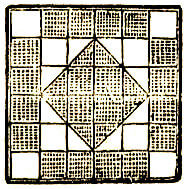 ויהיה מדת מה שנזרע בזו הערוגה כ״ד טפחים, ואמרינן בגמרא פרק ר׳ עקיבא דבערוגה בחרבה שנינו אבל ערוגה בין הערוגות אסור לזרוע בה חמשה מינין שאם יזרע בכל רוח שבערוגה זו ובכל רוח שבערוגה שסביבותיה יראה הכל כמעורב. והר״ר שמשון ז״ל פי׳ ע״פ הירושלמי דכך הוא סדר הזריעה, מניח בקרנות חרב טפח וחצי חומש על טפח וחצי חומש כדי שיתרחק זרע מזרע, זרע מזרח מזרע דרום שיעור אלכסון של טפח וחצי חומש, דהיינו טפח וחצי, וזורע בכל רוח ארבע טפחים חסר חומש באורך ורוחב טפח ומחצה אלא שמיצר והולך בכל צד עד שיהא כלה לרוחב טפח חסר חומש כדי שיהא לעולם בין זרע דרום לזרע מזרח טפח וחצי, וכן לכל רוח עד שיהא מניח באמצע הערוגה שלשה על שלשה ועושה באמצע נקב וזורע בו גרעין א׳ כזה
 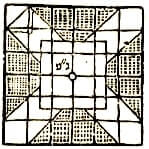 . והקשו בגמרא מאי דוחקיה לאוקמיה בערוגה שבחרבה יקיפוה ערוגות מכל צד כנגד הקרנות ואין בה דבר זרוע, ותרצו גזירה שמא ימלא הקרנות ויזרע הערוגה על זו הצורה
 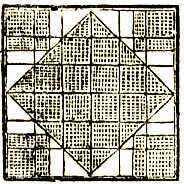 : או על זו הצורה
 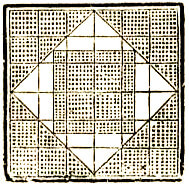 : והטעם שלא אמרו בערוגה שהיא ששה על ששה טפחים זורעין בתוכה ט׳ זרעונין ויהיה בין כל אחד טפח ומחצה כזה
 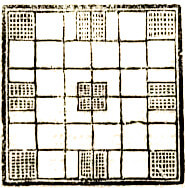 . לפי שכל הנזרע ממנה הוא ט׳ טפחים בלבד ועל זו שהקדמנו יהיה כ״ד טפחים, והא דנקט ערוגה ששה על ששה לפי שהיא היותר קטנה שבערוגות שהיא אמה על אמה והשמיענו שאפשר לזרוע בה זרעים משתנים ולא יהיו כלאים:
היה לה גובל גבוה וכו׳ בירושלמי אמרו שגם רוחב הגובל טפח נמצאת הערוגה ח׳ על ח׳:
זורעין בתוכה שלשה עשר. שלשה על כל גובל וגובל וא׳ באמצע כזה 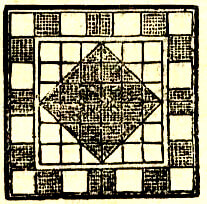 . ויהיה מדת הזרוע ממנה שלשים טפחים. והרא״ש ז״ל פי׳ על כל גובל וגובל זורע ד׳ בד׳ הקרנות ובין כל קרן וקרן שני מיני זרעים והא דקתני שלשה על כל גובל משום דקרן אחד נמנה עם השנים ומונה קרן אחת לכל רוח ובין ד׳ מינין שבכל רוח צריך להרחקת שלשה אוירין שביניהם ד׳ טפחים וחצי, וישאר למקום זרע ד׳ מינין ג׳ טפחים ומחצה והוא לכל מין טפח חסר שמינית טפח. ובירושלמי פריך וניתני ג׳ על כל גובל וגובל וחמשה באמצע כמו בערוגה דרישא ולהוי י״ז מינין ומשני משום שהגבולים ממעטים, פי׳ שצריך להרחיק זרע הערוגה מזרע הגבול טפח ומחצה ולא נשאר מקום פנוי לזרוע בערוגה כי אם שלשה על שלשה. וא״ת למה לא יזרע על כל גובל וגובל חמשה מינין ששה טפחים לד׳ אוירים שבין חמשה מינין וישאר שני טפחים לחמשת המינין. שני חומשי טפח לכל מין באורך טפח ויהיו בין הכל ט״ז מינין. ויש לומר דשמא ברבוי המינים איכא ערבוביא:
מפני שהוא ממלאהו. ולא יוכל לזרוע ג׳ בכל גובל:
רבי יהודה אומר ששה באמצע. בירושלמי דריש זרע זרעה זרועיה הרי תלתא, דהו״מ למיכתב זרע וכתיב זרועיה ותוציא צמחה תצמיח תלתא הרי ששה. וכתב הר״ש ז״ל דבירושלמי פריך למאי דשנינן לעיל לרבנן שהגבולין ממעטין היכי תני ר׳ יהודה ששה באמצע, ואי תימא ר׳ יהודה ארישא קאי פי׳ שאומר ת״ק חמשה והוא אומר ששה הא תני ר׳ חייא ר׳ יהודה אומר י״ח באמצע אלמא אסיפא קאי, ופירוש ששנים עשר על הגבול וששה באמצע הרי שמונה עשר ואינו מתרץ כלום בירושלמי. הלכך נראה שגובה הגבול עולה למנין הריחוק דאי לא תימא הכי אמאי נקט היה לה גובל גבוה טפח ליתני היתה הערוגה ח׳ על ח׳ אלא ודאי תנא גבוה טפח לאשמעינן שהגובה בכלל מדת הריחוק. וצריך לומר דר׳ יהודה לטעמיה דאמר בפירקין כמלא רוחב הפרסה דהיינו טפח ואין צריך להרחיק כי אם טפח והשתא כיון שגובה הגבול מן המנין לרבי יהודה יכול לזרוע בכל הערוגה. וזורע בה ששה מינין שלשה בשורה אחת מן המזרח ושלשה בשורה אחת מן המערב וכל מין ומין טפח ושליש טפח רוחב באורך ב׳ טפחים ומחצה, כזה: 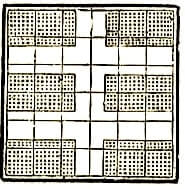 ורוחב כל זרוע מאלה טפח ושליש באורך שני טפחים ומחצה והקו הלבן החרב שבין ג׳ שורות שמצד זה לבין ג׳ שורות שמצד האחר, הם ששה טפחים באורך הערוגה, והחרב שבין זרוע לזרוע הוא שני טפחים וחצי כאורך הזרוע אבל רחבו טפח אחד כדעת ר׳ יהודה דלא בעי הרחקה רק טפח והם ד׳ אוירים שהן עשרה טפחים סך כל החרב בערוגה ששה עשר טפחים וסך כל הזרוע באמצע הערוגה מלבד הגובלין עולה עשרים טפחים: ולרבנן זורע מין אחד בערוגה חמשה על חמשה כי צריך חצי טפח מכל צד מן הגובל וא״ת לרבנן אמאי אינו זורע כי אם מין אחד בכל הערוגה והלא יכול לזרוע בה חמשה מינין טפח על טפח בכל קרן וקרן וטפח על טפח באמצע ובלבד שלא יהא אלכסון של טפח האמצעי כנגד אלכסון הערוגה, שאז לא יהיה טפח ומחצה בין זרע האמצעי לזרע הקרנות לפי שאלכסון הערוגה שבעה טפחים ואלכסון הזרעים של הקרנות והאמצעי ד׳ טפחים וחומש. וי״ל מדלא שרא רחמנא אלא חמשה בתוך ששה מכלל דפחות מששה איכא ערבוב. והר״מ ז״ל פי׳ שדעת רבי יהודה שאפשר שיזרע בזו הערוגה שהיא ששה על ששה ויש לה גבול טפח שמנה עשר מינין כזו הצורה:
 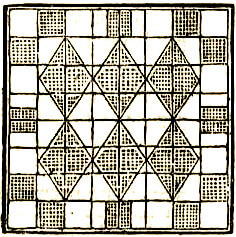 ויהיה מדת הזרוע ממנה שלשים טפחים וכשתסתכל בצורה זו תמצא ששה מסומנים אורך כל אחד ג׳ טפחים ורוחב שני טפחים נמצא כל צלע מהן אלכסון טפח ומחצה על טפח נמצאו הזרעים מרוחקים זה מזה יותר מטפח ומחצה. אמנם אם נרצה לומר לר׳ יהודה שיזרע ט׳ מינין בערוגה באמצע וכמדת הזריעה הזאת ונצייר אותה כמו זאת הצורה:
 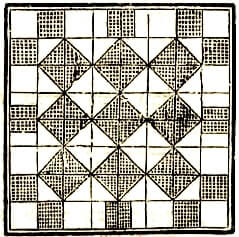 זה אי אפשר לפי שכל מסומן מהתשעה המסומנין המצויירין הוא ארכו שני טפחים ורחבו שני טפחים נמצא כל צלע מהם אלכסון טפח על טפח והוא טפח ושני חומשין ואנו צריכין לטפח ומחצה וליכא. והלכה כרבי יהודה:
Mishnah Yomi FAQ
What is Mishnah Yomi?
Mishnah Yomi is a daily study program where participants study two mishnayot (individual teachings from the Mishnah) every day. By following this program, one can complete the entire Mishnah in about six years.
What is the Mishnah?
The Mishnah is the first major written collection of Jewish oral traditions, forming the basis of the Talmud. It dates back to around 200 CE and consists of teachings and discussions of Jewish law by various rabbis.
Who started the Mishnah Yomi program?
In 1934, the Kozoglover Gaon, Rav Aryeh Tzvi Frommer, who took over from Rav Meir Shapiro (the founder of Daf Yomi) as the head of Yeshivas Chachmei Lublin, initiated the Mishnah Yomi cycle, focusing on Seder Zeraim and Seder Taharos. After World War II, in 1947, Rav Yonah Sztencl, a disciple of Rav Frommer, expanded the program, advocating for a comprehensive study of Shishah Sidrei Mishnah. The idea of studying two Mishnayos daily gained the support of figures like Rav Isser Zalman Meltzer, the Tchebiner Rov, and the Gerer Rebbe, marking the formal inception of Mishnah Yomi.
How long does it take to complete the Mishnah with Mishnah Yomi?
Following the Mishnah Yomi program, one can complete the Mishnah in approximately six years.
Can anyone join Mishnah Yomi?
Yes, anyone interested in studying the Mishnah can start the Mishnah Yomi cycle. There’s no need for prior knowledge; beginners are welcome.
Do I need to know Hebrew to study Mishnah Yomi?
While the Mishnah is originally in Hebrew, there are numerous translations and commentaries available in various languages, making it accessible to anyone interested in studying.
Is there a specific time of day to study Mishnah Yomi?
There’s no designated time. Participants can choose a time that best fits their schedule.
Can I study Mishnah Yomi with a group?
Yes, many communities and synagogues organize group study sessions for Mishnah Yomi. Studying in a group can enhance understanding and foster camaraderie.
What if I miss a day?
If you miss a day, you can catch up by studying the missed mishnayot alongside the current day’s study or by dedicating some extra time until you’re back on track.
Bartenura
תבואה נוטה על תבואה – as for example that they were sown according to Halakha but that sheaves within their growth are bent and lie one on top of the other, and similarly all of them.
מדלעת יונית – that its leaves are long and stretch more than they lean on the grain or on the vegetables that they become interwoven and tied up more than the rest of the species and look like mixed seeds.
ופול המצרי – PESHULI in the foreign language.
ורואה אני את דבריהן מדברי – that they do not have entangling but they become entangled like the Greek gourd. And such is the Halakha that everything is permitted except the Greek gourd.
תבואה נוטה על גבי תבואה. כגון שנזרעו כהלכתן אלא שהשבולים מתוך גדלן נכפפים ושוכבים זה על זה, וכן כולן:
חוץ מדלעת יונית. שעלין שלה ארוכים ומתפשטין ביותר וכשהן נוטין ע״ג תבואה או ירק הן מסתבכין ומתקשרין יותר מכל שאר מינין ומיחזו כלאים:
ופול המצרי. פשול״י בלע״ז:
ורואה אני את דבריהן מדברי. שאין בהן מסבכין ומסתבכין כדלעת יונית. וכן הלכה שהכל מותר חוץ מדלעת יונית: